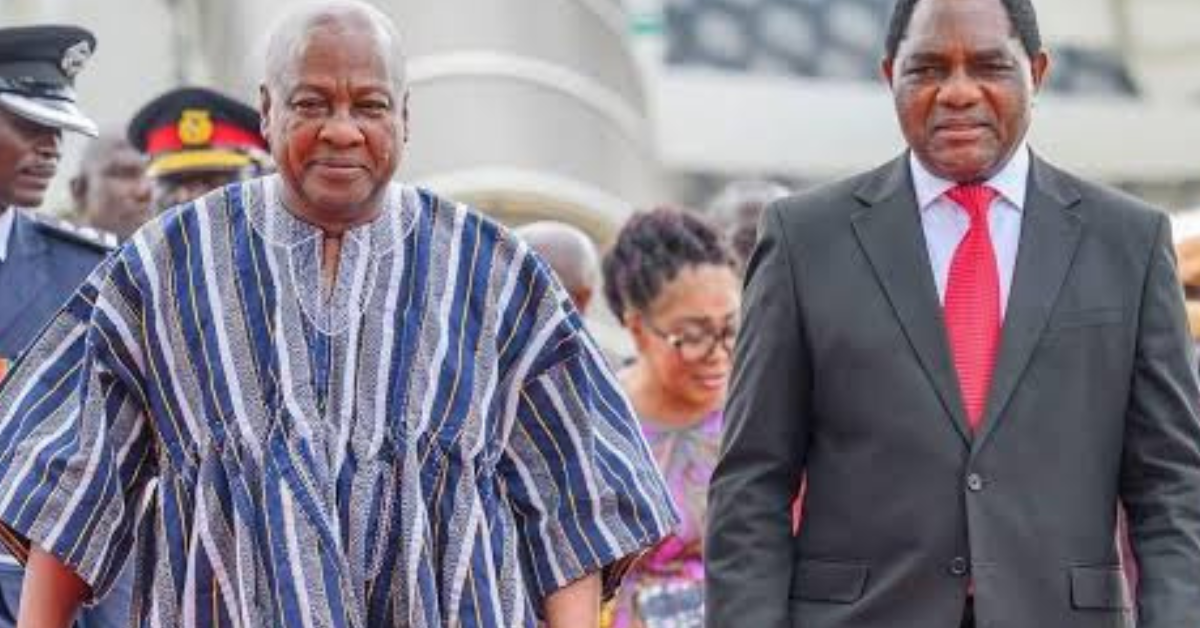
Ghana’s President John Mahama has revealed how a moment of public mockery during his official visit to Zambia turned into a strategic cultural breakthrough for Ghana, strengthening national pride and promoting the country’s iconic fugu attire on the global stage.
Speaking before Parliament, Mahama recounted how the traditional fugu outfit he wore during the Zambia trip sparked a wave of social media reactions. Some online users in Zambia questioned and mocked the attire. However, rather than reacting defensively, Ghana moved swiftly to reshape the narrative.
Instead of allowing the moment to spiral into negativity, officials and citizens amplified the cultural significance of fugu. They highlighted its heritage, craftsmanship, and symbolism. As a result, what began as online criticism quickly evolved into a cultural conversation.
Mahama explained that Ghana chose confidence over confrontation. The government corrected misconceptions and promoted fugu as a symbol of identity and creativity. Consequently, the situation transformed from a potential diplomatic embarrassment into a powerful display of soft power diplomacy.
Moreover, he stressed that the response reflected Ghana’s understanding of its brand equity. Citizens rallied behind a shared identity. Social media users defended the attire with pride. Designers and cultural advocates joined the conversation. Together, they turned confusion into connection and criticism into cross-border friendship with their Zambian counterparts.
According to the President, the episode demonstrated that Ghana knows who it is. It showed a nation aligned around culture, history, and purpose. Furthermore, it reinforced how cultural assets can strengthen international relations when handled strategically.
Mahama linked the incident to Ghana’s broader historical journey. He reminded lawmakers that Ghanaians descend from generations who resisted colonial oppression and economic exploitation. Therefore, unity remains essential for national development. He urged citizens to reject distortion and misrepresentation that undermine collective progress.
In addition, the President reaffirmed his leadership responsibility. “The buck stops with the President,” he stated, emphasizing accountability in public office. Nevertheless, he noted that nation-building does not rest on one individual. Instead, it depends on millions of citizens who translate policy into action every day.
From farmers and traders to teachers, nurses, artisans, entrepreneurs, and lawmakers, every Ghanaian plays a role. Consequently, national progress emerges from competence, integrity, and industry across all sectors. No single policy can replace civic duty. No government program can substitute for discipline and patriotism.
Mahama acknowledged that Ghana has faced economic strain and political transitions in recent years. However, he insisted that the country’s story cannot be defined by its challenges alone. Rather, it must be defined by how its people respond to adversity. Historically, Ghanaians have chosen cooperation over division and hope over despair.
Quoting an African proverb, he declared that no matter how long the night lasts, dawn will break. He argued that Ghana now stands at the edge of renewal. Yet renewal requires action, preparation, and shared responsibility.
Importantly, he emphasized that the republic belongs to all citizens, regardless of political affiliation. The farmer, the trader, the teacher, the entrepreneur, the youth, and the retiree each hold a stake in the nation’s future. Because of this shared ownership, every Ghanaian carries a duty to protect both development and cultural identity.
Mahama concluded on an optimistic note, describing Ghana as resilient and renewing. He declared that the nation stands on the brink of takeoff and called on citizens to fasten their seatbelts for the journey ahead.
Through what began as a fashion controversy during his Zambia visit, Ghana ultimately showcased strategic communication, cultural diplomacy, and national unity. In doing so, the country not only defended its heritage but also amplified it on a continental stage, reinforcing Ghana’s position as a confident voice in African cultural identity and soft power leadership.