K-pop has never been bigger, richer, or more powerful. Yet as the genre conquers new markets in 2026, many fans now ask one major question: is K-pop slowly losing its Korean identity
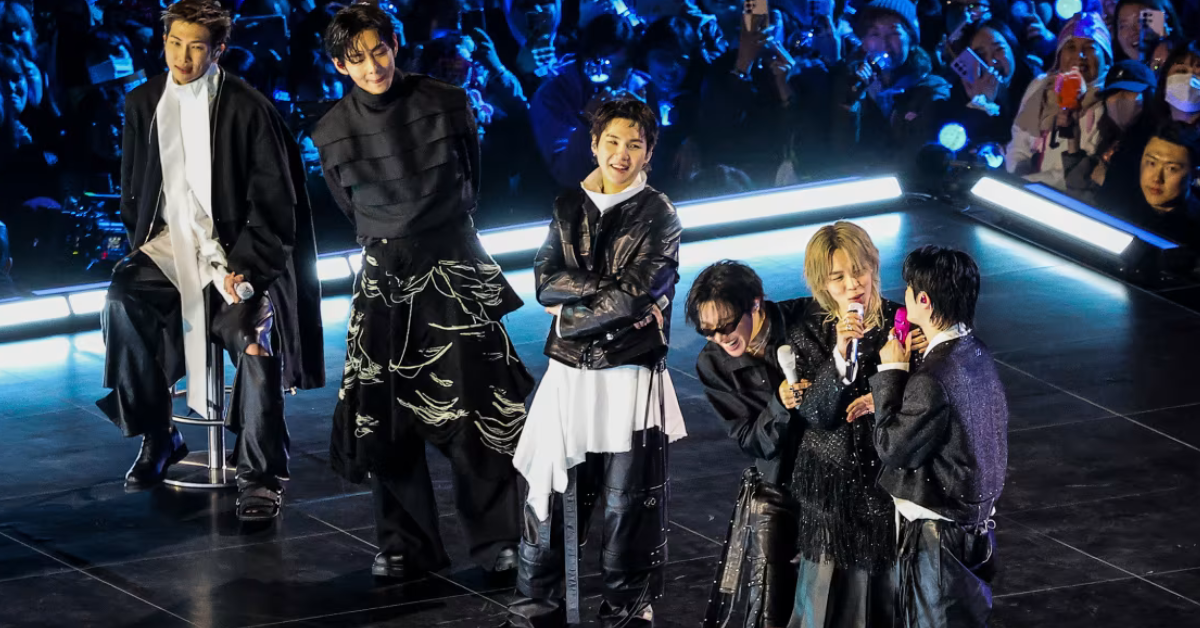
That debate intensified after BTS returned in March with a massive comeback concert in Seoul, ending nearly four years of hiatus caused by South Korea’s mandatory military service. The group remains one of the biggest music acts on Earth, and their return instantly grabbed headlines worldwide.
However, BTS came back to an industry that looks very different from the one they dominated in the 2010s.
K-pop has transformed from a niche genre into a multibillion-dollar global business. It now dominates streaming charts, sells out stadiums worldwide, drives tourism to South Korea, and fuels the country’s cultural influence across fashion, beauty, food, and entertainment.
Experts say the industry has entered what fans call the “fifth generation” of K-pop. This new era focuses less on traditional boundaries and more on global expansion.
That shift is easy to spot.
Blackpink’s new mini album Deadline features mostly English-language songs. Meanwhile, newer groups now debut outside South Korea with members who may have no Korean roots at all.
As a result, many longtime fans wonder whether K-pop still needs to be Korean.
The answer may depend on how you define K-pop in the first place.
Unlike many local music industries, K-pop was designed for export from the beginning. Since the 1990s, entertainment companies built groups with international audiences in mind. Agencies created catchy English-friendly names, trained idols in foreign languages, and added multinational members to attract fans in Japan, China, Southeast Asia, Europe, and North America.
Now that strategy has expanded further.
Labels increasingly recruit talent from Latin America, the United States, Europe, and other regions. Songwriters, choreographers, producers, and creative directors often come from different countries.
That means modern K-pop is becoming less about nationality and more about a formula.
The best example is Katseye, the Los Angeles-based girl group backed by HYBE, the company behind BTS. The group sings mainly in English and features members from diverse backgrounds, yet it was built through the intense training system that made K-pop famous.
This has divided fans online.
Some insist Katseye is absolutely K-pop because it follows the Korean idol development model. Others argue it cannot be K-pop without Korean culture, language, or roots.
HYBE itself calls Katseye a “global girl group formed using K-pop methodologies.”
That phrase may define the future of the genre.
Instead of exporting only Korean artists, companies now export the K-pop system itself, trainee programs, polished visuals, fandom communities, merchandise strategies, storytelling, choreography precision, and social media engagement.
Still, critics continue to challenge that system.
Many former idols and observers have spoken about strict contracts, intense schedules, dating restrictions, mental health pressure, and unrealistic standards. Yet supporters argue the same disciplined structure helps create some of the world’s most polished performers.
Even with controversy, the money keeps growing.
Major K-pop agencies including HYBE, YG, SM, and JYP reportedly saw combined revenue surge to around $3 billion between 2019 and 2024. The industry remains one of Asia’s strongest entertainment exports.
BTS also continues to prove its power.
The group reportedly sold out 41 stadium shows across North America, Europe, and the UK for its current world tour. Their new album Arirang posted one of the biggest first-week debuts for any group in recent years.
Still, repeating BTS-level success may be difficult.
Timing helped BTS dominate globally. They mastered social media before rivals caught up, then expanded during the pandemic when audiences lived online. Replicating that exact moment may be impossible.
Meanwhile, younger fans now consume music differently. Viral choreography clips, faster songs, and short-form content increasingly shape success.
That trend pushes K-pop toward a more hyper-digital future.
Yet one major issue remains unresolved: will fans embrace a version of K-pop with less Korea inside it?
For many international listeners, Korean culture was the attraction from the start. They loved hearing Korean lyrics, seeing Korean stars succeed globally, and discovering Seoul through music.
K-pop also introduced millions to the wider Korean Wave, known as Hallyu, which boosted K-dramas, Korean skincare, fashion, and food around the world.
If the Korean element fades, some fear the emotional connection could weaken.
Others believe evolution is necessary.
Music genres constantly change, and younger audiences often demand something new. K-pop’s greatest strength may be its ability to reinvent itself before trends die.
That is why 2026 could become a turning point.
BTS has returned. Blackpink keeps expanding globally. HYBE is building new international acts. And fans everywhere are deciding what K-pop should become next.
One thing is certain: K-pop is no longer just South Korea’s music industry.
It is now a global cultural force and the whole world wants a piece of it.