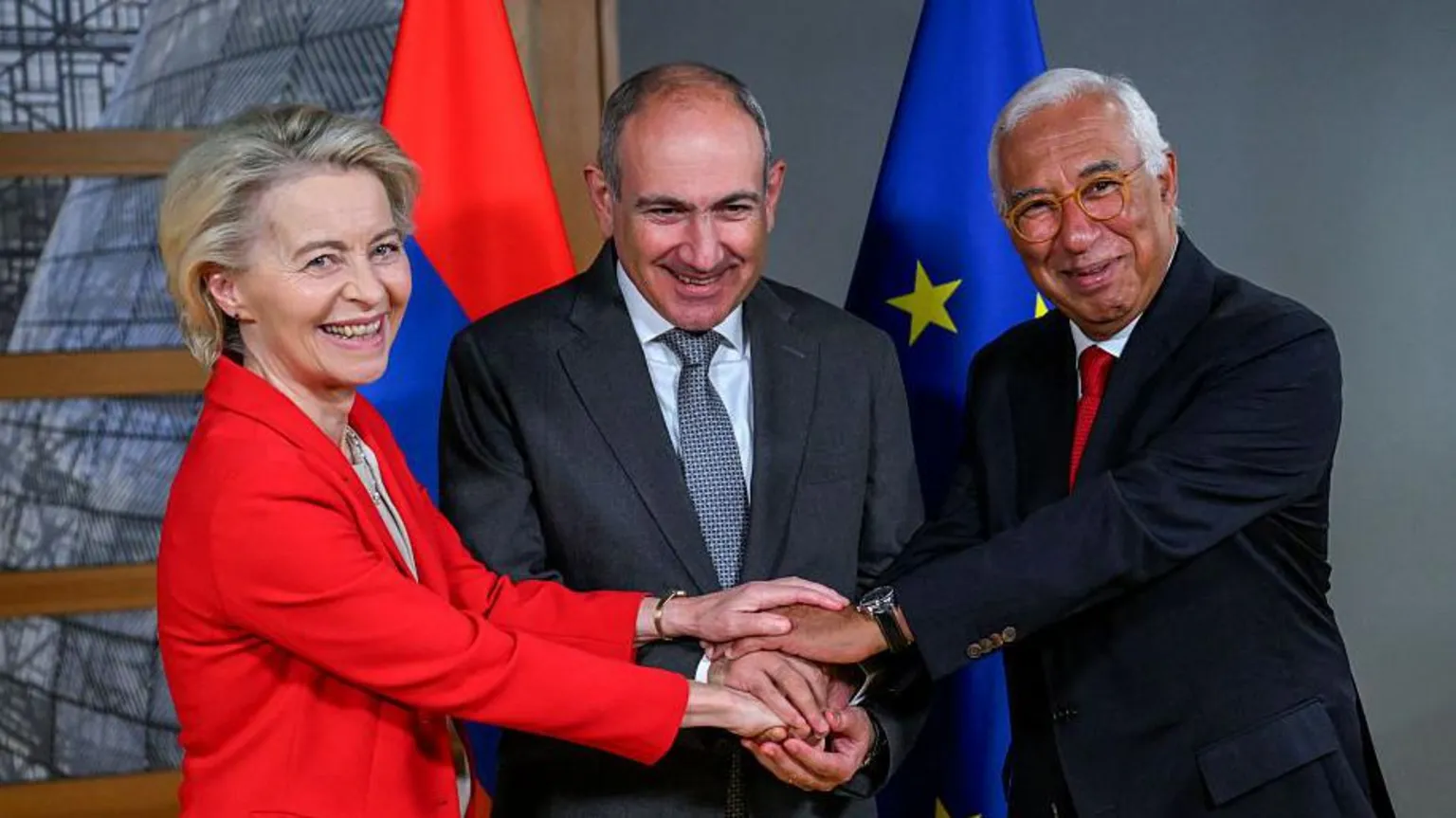
European leaders are gathering in Armenia in what has become one of the most significant diplomatic moments in the South Caucasus in decades. Over 30 heads of state and government are arriving in Yerevan for a major European Political Community summit, followed immediately by the first-ever bilateral European Union–Armenia summit. The visit marks a clear shift in Armenia’s foreign policy direction and signals growing friction with Russia, its long-time security partner.
Armenia, a country of fewer than three million people, has long sat inside Russia’s strategic orbit. It remains part of the Eurasian Economic Union and continues to rely heavily on Russian gas supplies. Moscow also maintains a military base on Armenian territory, reinforcing decades of security dependence. However, that balance has started to shift rapidly in recent years.
The turning point came after the collapse of Armenian control over Nagorno-Karabakh in 2023, when Azerbaijan launched a swift military operation that led to the displacement of more than 100,000 ethnic Armenians. Russia, despite hosting peacekeepers in the region, did not intervene in the crisis. At the same time, earlier border tensions exposed limits in the Russia-led Collective Security Treaty Organisation, leaving many in Yerevan questioning its reliability.
Armenian officials say those events forced a rethink. Sargis Khandanyan, who chairs the foreign relations committee in Armenia’s parliament, said the country realised its security framework was failing. As confidence in Moscow weakened, the European Union increased its presence through civilian monitoring missions and diplomatic engagement.
That engagement has now evolved into deeper political alignment. In March 2025, Armenia’s parliament formally initiated the EU accession process. Since then, relations have accelerated, with both sides expanding cooperation in governance, infrastructure, and security coordination. European Commission President Ursula von der Leyen and European Council President António Costa are leading the EU delegation in Yerevan.
At the same time, Armenia and Azerbaijan have pushed forward a fragile peace process. In August, both countries signed a landmark agreement in the United States aimed at ending decades of conflict. They also introduced a new regional connectivity plan, designed to link Armenia to wider European markets through a transit corridor along its border with Iran. However, tensions remain unresolved, especially after Azerbaijan suspended ties with the European Parliament following recent EU resolutions on human rights and displaced populations.
Russia, meanwhile, has reacted with growing frustration. President Vladimir Putin has publicly highlighted the cost advantage Armenia enjoys on Russian gas compared to Europe, while also warning that Armenia cannot simultaneously pursue full EU integration and remain inside the Eurasian Economic Union. Just days before the Yerevan summit, Russia imposed restrictions on imports of Armenian mineral water, a move analysts interpret as part of broader pressure tactics.
Security experts in Armenia describe a rising wave of hybrid pressure, including cyberattacks, disinformation campaigns, and economic disruptions. Artur Papyan of CyberHUB-AM said online influence operations have intensified ahead of Armenia’s elections, with coordinated narratives spreading across social platforms. He also pointed to hacking attempts targeting government systems and fake accounts impersonating EU officials.
The European Union has responded by approving a new two-year civilian mission aimed at strengthening Armenia’s resilience against cyber threats, disinformation, and illicit financial flows. The mission builds on similar EU operations in Eastern Europe, including Moldova, where pro-EU governments recently retained power despite external pressure.
Council of Europe Secretary General Alain Berset, attending the summits, warned that Armenia’s democratic institutions face growing strain. He highlighted the risks of foreign interference and online political polarisation, especially ahead of the June parliamentary elections. While Armenia has legal tools to counter these threats, he noted they remain insufficient against the scale of modern hybrid warfare.
Despite the diplomatic momentum, Armenia’s long-term position remains uncertain. The European Union has not offered a clear timeline for membership, nor has it committed to replacing Russian energy supplies or providing formal security guarantees. As a result, Armenia continues to walk a delicate diplomatic line between East and West.
Still, the symbolism of hosting Europe’s top leaders in Yerevan is powerful. It reflects a nation actively redefining its place in a rapidly shifting geopolitical landscape.