Africa’s Energy Transition Opportunity
By NJ Ayuk, Executive Chairman, African Energy Chamber
Africa stands at the center of a global debate it did not start, yet one it cannot escape.
Across international climate forums, the chant is familiar: net zero, net zero, net zero. Western economies push for rapid decarbonization. Investors follow the trend. Policies tighten. However, the numbers tell a different story when Africa enters the conversation.
Today, the continent produces less than five percent of the world’s energy-related emissions, despite carrying nineteen percent of the global population. By 2060, Africa will hold nearly twenty-eight percent of humanity. Even then, its emissions will likely rise to just nine percent.
These figures, drawn from the African Energy Chamber’s State of African Energy: 2026 Outlook Report, reveal a quiet truth. Africa did not fuel the climate crisis. Yet it now faces pressure to solve it.
Still, within this contradiction lies an opportunity.
Because Africa uses little energy per person, it can leap forward differently. It can grow while staying cleaner than older industrial economies. It can expand electricity access without locking itself into decades of heavy emissions. In short, Africa can help shape global decarbonization—on its own terms.
That path, however, will not be simple.
Across the continent, weak grids, aging transmission lines, and limited generation capacity slow progress. Millions still live without reliable power. Hospitals ration electricity. Small businesses close early. Students study by candlelight.
So the challenge becomes clear: Africa must expand energy access first, while transitioning to cleaner systems at the same time.
This dual mission defines the continent’s energy story.
Building solar farms and wind parks alone will not fix the problem. Countries must modernize grids, reform regulations, train engineers, and attract long-term investment. Meanwhile, new global shipping and emissions rules create another opening. With the right infrastructure, Africa could supply the world with green fuels.
Yet capital remains scarce.
Investors often hesitate. Political risk looms large. Permits move slowly. Policies change too often. At the same time, many nations depend heavily on oil and gas exports to fund schools, roads, and healthcare.
As a result, leaders must walk a narrow bridge between today’s revenues and tomorrow’s clean economy.
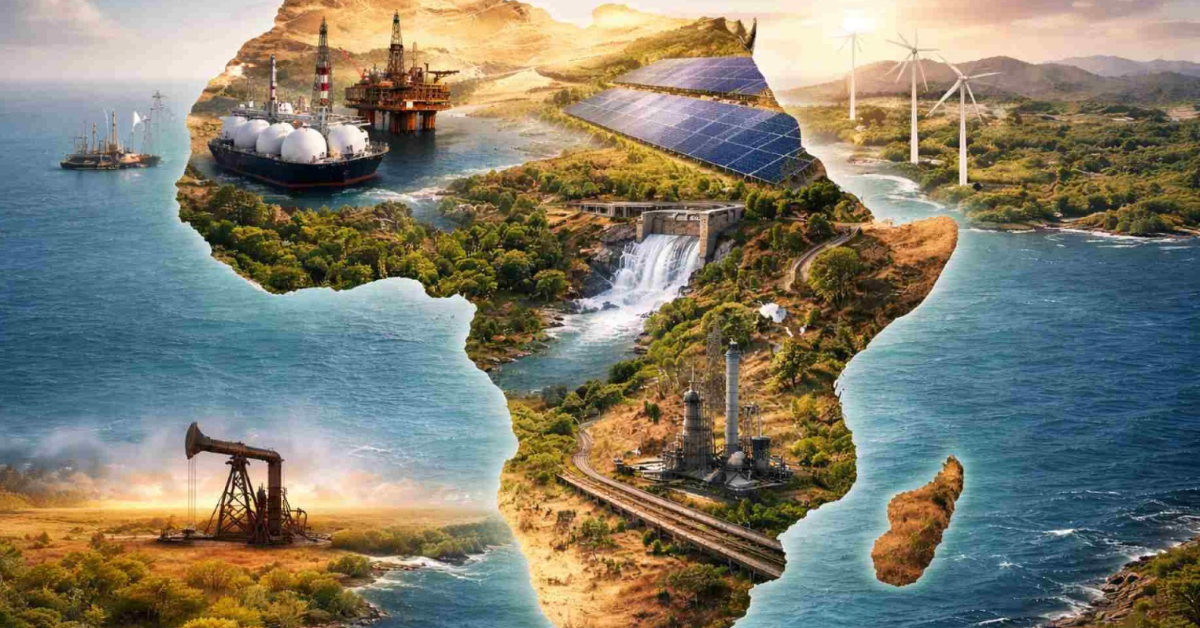
Even so, Africa’s energy profile continues to evolve. Beyond oil and gas, hydrogen and critical minerals now dominate strategic discussions. Together, they form the backbone of the continent’s next economic chapter.
Green hydrogen: Africa’s quiet revolution
By 2035, Africa could produce more than nine million tonnes of low-carbon hydrogen each year.
That scale would reshape global energy markets.
Sun-rich deserts, strong coastal winds, vast land, and proximity to Europe and Asia give the continent a natural advantage. Hydrogen can travel by pipeline from North Africa to Europe. Alternatively, producers can convert it into ammonia for global shipping.
Already, momentum is building.
Namibia leads the charge. The country hosts the $10 billion Hyphen Green Hydrogen Project, developed by Hyphen Hydrogen Energy, a partnership between Enertrag of Germany and Nicholas Holdings. The project targets over 300,000 tonnes of hydrogen annually for export.
Nearby, another initiative turns hydrogen into steel. The HyIron Oshivela project uses solar power, batteries, and electrolyzers to create green hydrogen that strips oxygen from iron ore. The result is direct-reduced iron, a cleaner input for steelmaking.
Meanwhile, construction continues on the Daures Green Hydrogen Village, Africa’s first fully integrated hydrogen and fertilizer hub, linking renewable energy with sustainable agriculture.
Across the border, South Africa has mapped out its own hydrogen future.
Its “Hydrogen Valley” clusters public and private investment around large projects. The Coega Green Ammonia Plant, valued at $5.7 billion, plans to produce 1.2 million tonnes annually. In the Northern Cape, the Prieska Power Reserve Project prepares to generate hydrogen from sun and wind. Sasol already runs a pilot plant in Sasolburg. Elsewhere, the HySHiFT consortium explores sustainable aviation fuel made with green hydrogen.
Northward, Mauritania pursues mega-scale ambitions. Project Nour (Aman) alone aims for 1.7 million tonnes of hydrogen per year. Separately, the government signed a $34 billion deal with Conjuncta to develop a 10-gigawatt hydrogen facility.
Morocco, one of Africa’s early movers, now anchors its strategy to European demand. The government allocates land near ports and builds shared infrastructure while partnering with players like TotalEnergies and the European Investment Bank.
Egypt also races ahead. In the Suez Canal Economic Zone, the Ain Sokhna plant operates as Africa’s first green hydrogen facility. Meanwhile, Cairo has secured more than $17.4 billion in commitments for future projects.
To coordinate progress, countries formed the African Green Hydrogen Alliance in 2022. The bloc now includes eleven members and projects exports of forty megatons by 2050.
Hydrogen, once theoretical, now shapes national budgets and foreign policy.
Critical minerals: Africa’s strategic leverage
Energy transition does not run on electrons alone. It runs on minerals.
Lithium for batteries. Cobalt for stability. Copper for wiring. Platinum for fuel cells.
Africa holds them all.
By 2035, global demand for critical minerals could multiply five times over. That surge places African producers in a position of rare strength.
The Democratic Republic of Congo already dominates cobalt. In 2024, seven of the world’s ten largest cobalt mines sat within its borders. The country also ranked second in copper output. To protect prices, the government imposed an export ban in early 2025, later replacing it with quotas through 2027.
Lithium tells a similar story.
Zimbabwe, Mali, Ghana, Namibia, and the DRC produced over 124,000 metric tonnes of lithium carbonate equivalent in 2024. Production could rise more than 150 percent by 2030.
Zimbabwe stands out. Two of the world’s top ten lithium mines operate there. Together, they deliver over seven percent of global output. The government now bans raw ore exports, charges royalties, and supports a $450 million refinery in Mapinga.
These moves signal a shift. Africa no longer wants to export rocks and import wealth. It wants to process, refine, and manufacture.
Global powers are paying attention.
Both the United States and China seek long-term mineral partnerships. Bilateral agreements multiply. Joint ventures grow. Value chains stretch deeper into African soil.
Still, success will depend on more than geology.
What must change to unlock Africa’s full potential
First, regulation must stabilize.
Investors need clarity. They need predictable taxes, transparent licensing, and consistent enforcement. Without these, refineries remain plans on paper.
Second, countries must cooperate.
Shared rail lines, ports, renewable corridors, and industrial zones can lower costs and speed development. Harmonized export rules and environmental standards can turn fragmented markets into one competitive region.
Third, skills must grow.
Refining minerals and running hydrogen plants demand engineers, chemists, and technicians. Governments should fund training, reward local hiring, and support research partnerships with universities and global institutions.
Finally, human dignity must remain non-negotiable.
Africa cannot repeat the mistakes of past extractive booms. Laws must ban child labor, protect indigenous land, enforce safety standards, and safeguard ecosystems.
If leaders act wisely, the rewards will stretch far beyond export earnings.
They will power factories. Light homes. Fuel industries. Create jobs. Lift millions from energy poverty.
Africa did not design the climate crisis. Yet it may help solve it.
The continent now faces a historic choice: remain a supplier of raw materials, or rise as a clean-energy powerhouse.
With hydrogen in its deserts and minerals beneath its soil, Africa already holds the tools.
What happens next depends on leadership, investment, and courage.
And on whether the world finally listens to Africa’s voice in shaping the future of energy.