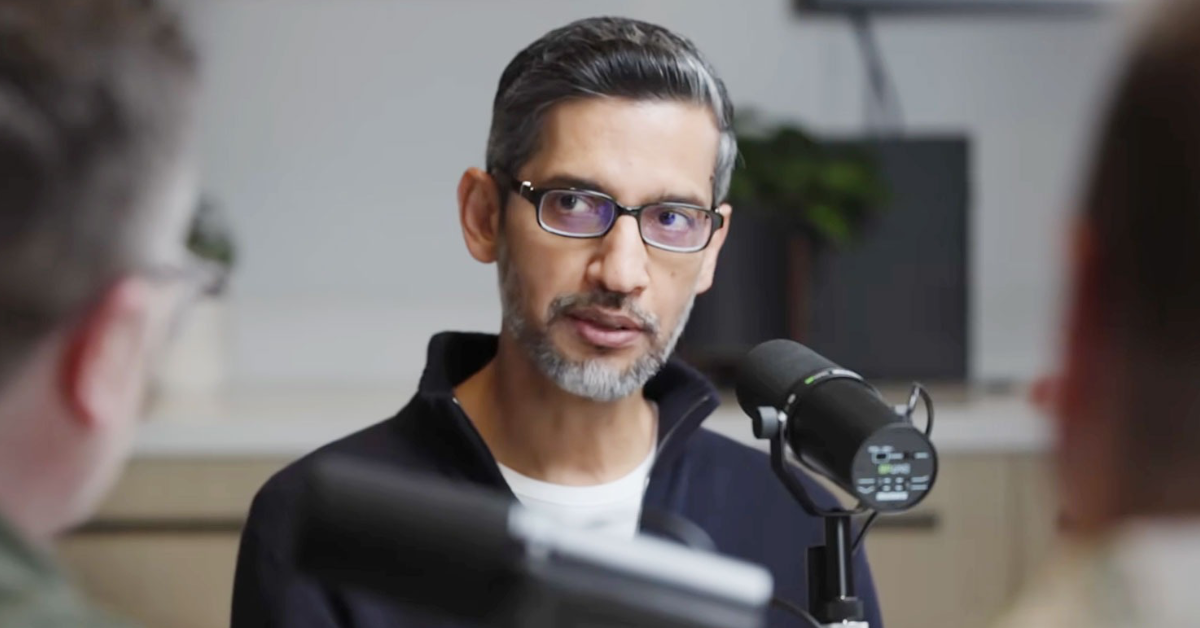
Google CEO Sundar Pichai has made his position clear: the future of Google Search will increasingly revolve around artificial intelligence, and the company is comfortable with that transition.
In a recent interview, Pichai described Google’s evolution toward AI Mode as a gradual process rather than a sudden replacement of the traditional search experience. His comments offer one of the clearest indications yet that Google sees AI-powered search as a central part of its future, even if that future fundamentally changes how people interact with the web.
For years, Google’s familiar interface has revolved around the “ten blue links” that direct users to websites across the internet. Today, however, AI-generated answers are becoming more prominent, creating a search experience that delivers information directly within Google rather than sending users elsewhere.
Pichai acknowledged that many people expect the classic search interface to eventually disappear. Yet he emphasized that Google intends to bring users along carefully rather than forcing an abrupt shift.
According to Pichai, user response to AI Mode has been overwhelmingly positive. He said Google’s long-term internal metrics show strong engagement and satisfaction, reinforcing the company’s confidence that consumers are embracing AI-powered search experiences.
At the same time, he stressed that Google understands people still want access to the broader web. That is why sources and links remain part of AI-generated answers.
“People are looking to connect with what’s out there on the web,” Pichai explained, adding that citations and source links will continue to play a role in Google’s AI search products.
While that reassurance may sound comforting to website owners, publishers and SEO professionals view the situation differently.
The core concern is that visibility is not the same as traffic.
When AI Mode provides an answer directly within Google’s interface, users often get the information they need without clicking through to the original source. As a result, publishers may receive attribution while losing valuable referral traffic that drives advertising revenue, subscriptions, and audience growth.
This challenge has fueled growing discussions around what many digital marketers now call “Google Zero”—the idea that businesses should prepare for a future in which Google sends little or no meaningful traffic to external websites.
Under that scenario, brands, publishers, and content creators would need to build direct relationships with audiences through newsletters, memberships, subscriptions, social media communities, and owned platforms rather than relying heavily on search referrals.
Pichai’s comments suggest Google recognizes this shift but remains confident in its direction.
During the interview, he also addressed concerns about Google’s advertising business. One interviewer noted that many users now rely on AI tools instead of conducting traditional Google searches and asked whether that trend worries the company.
Pichai’s answer hinted at a future where Google’s revenue may come from a combination of advertising and subscription products.
He argued that AI systems will ultimately provide more value to users than traditional search experiences did a decade ago. As that value grows, Google believes it can sustain its business through multiple monetization models, including premium subscriptions alongside advertising.
The remarks stand out because they offer one of the strongest indications yet that Google is exploring a broader economic framework for the AI era.
For publishers, however, the larger question remains unresolved.
If AI-generated answers become the primary gateway to information, how will the websites producing that information continue to thrive?
That concern has become more urgent as AI systems increasingly summarize content, answer questions, and satisfy user intent without requiring a click. Critics argue that while attribution remains visible, the economic value traditionally generated by website visits continues to decline.
Pichai also pushed back against growing public skepticism toward artificial intelligence. Despite rising concerns about AI’s impact on jobs, energy consumption, water usage, and the broader economy, he maintained that user behavior shows people are finding value in AI-powered experiences.
He compared today’s AI revolution to transformative technologies such as spreadsheets, which dramatically increased productivity in finance and business.
According to Pichai, AI will help professionals across industries become more productive, automate repetitive tasks, and free up time for higher-value work.
Yet critics argue that such comparisons overlook the unique challenges facing the modern web ecosystem. Unlike previous technological shifts, AI-powered search changes how information is discovered, consumed, and monetized.
Google appears convinced that the web can continue to function even as AI increasingly mediates access to information. Publishers, meanwhile, are asking a different question: can the open web remain economically sustainable if visibility no longer translates into visitors?
As Google accelerates its AI-first strategy, that debate is likely to define the future of digital publishing, SEO, online advertising, and content creation for years to come.
For now, one message from Sundar Pichai is unmistakable: AI Mode is no longer an experiment. It is rapidly becoming Google’s vision for the future of search.