Rwanda did not buy football success. It engineered visibility at a scale most nations never imagined possible.
What began as a quiet tourism branding experiment has evolved into one of the most sophisticated sports marketing operations in modern history. Today, Visit Rwanda appears across Arsenal, Paris Saint-Germain, Bayern Munich, and Atlético Madrid, four of Europe’s most influential football clubs.
The strategy traces back to President Paul Kagame, a long-time Arsenal supporter who often spoke openly about the club and its culture. When the Premier League introduced sleeve sponsorships, Rwanda moved quickly. Instead of competing in raw spending wars with Gulf states, it chose a different path: efficiency over excess.
In 2018, Arsenal announced the Rwanda Development Board as its first-ever sleeve sponsor. Critics in Europe questioned the deal, especially as Rwanda also received development aid. However, Kigali framed the partnership differently. Officials argued it was not charity spending but calculated media investment through tourism marketing.
An Arsenal shirt reportedly reaches tens of millions of daily global impressions. Over a full season, that exposure compounds into billions of brand views. Rwanda treated this as a global billboard, not a football sponsorship.
The results soon validated the approach. Early performance reports linked the Arsenal partnership to a measurable rise in tourism interest, including increased UK visitor arrivals and millions in brand value exposure.
Rwanda then scaled the model instead of slowing down.
By 2019, Paris Saint-Germain became the next target. PSG’s financial pressure and global superstar strategy created an opening. The club needed credible commercial partners to balance UEFA financial fair play requirements, especially after record-breaking transfers involving Neymar and Kylian Mbappé.
Rwanda entered the agreement with PSG at a relatively modest valuation compared to Gulf sponsorship deals. However, it secured far more visibility than its spending suggested.
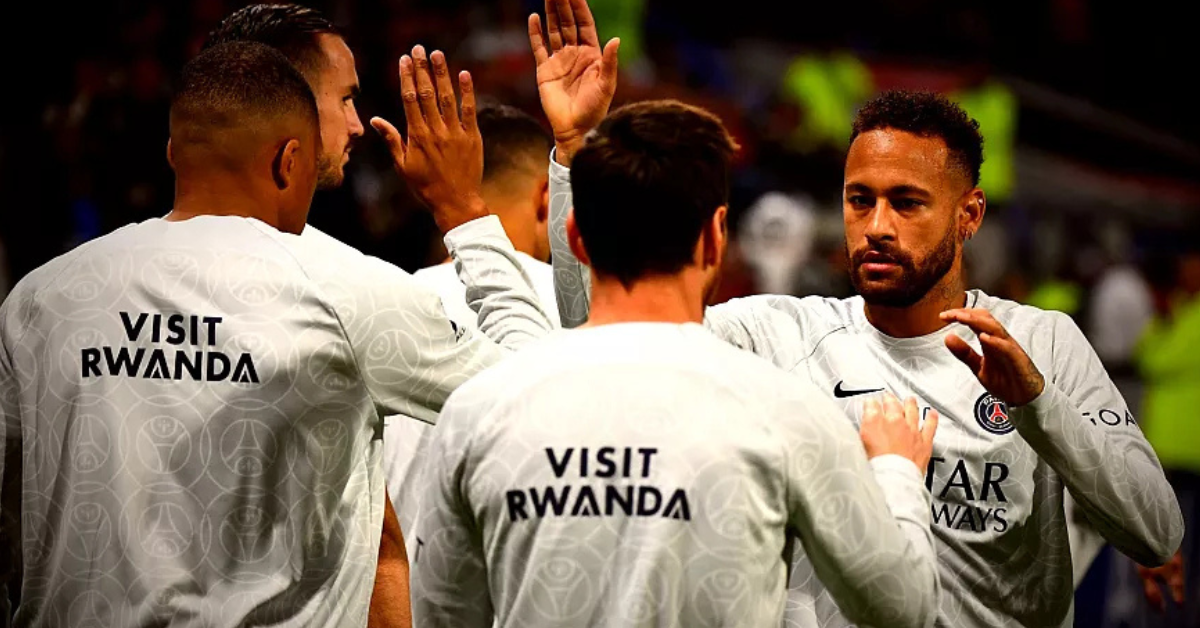
The branding extended far beyond shirts. Visit Rwanda appeared on training kits, stadium LED boards, media backdrops, and global content campaigns. The strategy shifted from passive advertising to immersive tourism storytelling.
That approach delivered one of the most viral marketing moments in modern football history. A widely shared hug between Sergio Ramos and Lionel Messi, both wearing PSG gear featuring Visit Rwanda branding, generated tens of millions of views across platforms. The campaign multiplied across TikTok, Instagram, X, and YouTube, extending its reach into hundreds of millions of impressions.
Rwanda did not stop at visibility. It turned football partnerships into physical tourism pipelines.
PSG players visited Rwanda in 2022, where they toured Akagera National Park and trekked mountain gorillas. These visits turned global athletes into live ambassadors for Rwandan tourism. At the same time, Kigali hosted youth football exchanges where players like Sergio Ramos engaged directly with young Rwandan athletes.
Unlike traditional sponsorships, Rwanda built infrastructure around its deals. PSG now runs an academy presence in Kigali. Bayern Munich established a development partnership. Atlético Madrid later joined as Rwanda expanded into La Liga in 2025.
Each deal followed a consistent pattern: low relative cost, high global visibility, and long-term tourism conversion potential.
Bayern Munich added further credibility through Bundesliga branding and academy expansion in Kigali. Atlético Madrid strengthened Rwanda’s La Liga presence, ensuring the country now appears across four of Europe’s biggest football leagues.
The combined effect is unprecedented. A small East African nation now appears on the kits, training gear, and media assets of clubs competing at the highest level of global football.
Financially, the strategy remains controversial yet compelling. While Gulf states spend billions annually on sports sponsorships, Rwanda operates at a fraction of that scale. Yet analysts argue it extracts some of the highest cost-per-impression efficiency in global sports marketing.
Tourism revenue now exceeds half a billion dollars annually for Rwanda, with branding campaigns playing a central role in its growth.
Still, critics continue to question the optics of a developing nation investing in elite European football while relying on external aid. Supporters counter that Rwanda has simply redefined modern nation branding, turning football into a global marketing engine that delivers measurable economic returns.
What makes Rwanda’s strategy remarkable is not just where its logo appears, but how consistently it appears where global attention is highest, Champions League nights, superstar signings, viral social moments, and championship finals.
In the end, Rwanda did not buy football clubs. It bought attention efficiency.
And in the modern attention economy, that may be the most valuable currency of all.

- Burna Boy Becomes First Nigerian Artiste to Hit 4 Billion YouTube Views
- Serena Williams’ Nike Jacket Celebrates a Legacy of US Open Dominance

- Tanzania to Host the 74th Miss World Festival in May 2027

- Beyoncé Drops Pharrell Track on 20th Anniversary Birthday

- Jay Z Stuns London With Beyoncé Tribute and Fugees Reunion